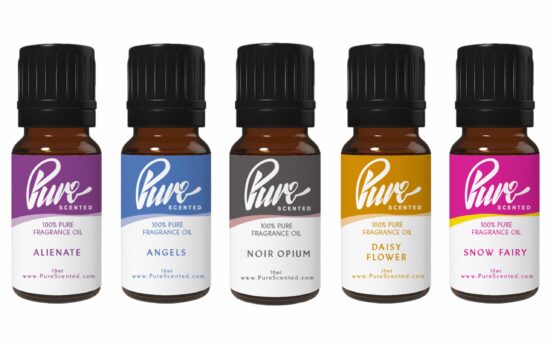
What the law says about labelling candles, wax melts, reed diffusers and room sprays made with our fragrance oils, and our ready-made room sprays. Why our labels and label creator show what they show, and what is down to you.
The short version
If your name is on the product, the label is your responsibility. You are the supplier, not us.
Our 10% and 25% CLP labels tell you what our fragrance oil adds to a product at 10% or 25% in a base that is not hazardous itself. At a lower amount they won’t miss a warning, but they may show more than your product needs (see the common questions). They are information for you to use. They are not a finished label for your product.
Our free label creator makes labels for candles and wax melts made with up to 10% of one of our oils, reed diffusers in Augeo, our ready-made room sprays and room sprays made with one of our oils in our Perfumers Alcohol. For candles and wax melts it leaves out some lines that are on our PDF labels (section 3).
For reed diffusers we also have CLP labels and an SDS for each suitable oil in Augeo Clean Multi or Augeo Crystal Clean, made at the most that oil’s IFRA certificate allows, up to 25%. There is a CLP label for every bottle size, and a 125 ml and under version that you may only use if the full label won’t fit on the bottle, even as a fold-out label, a tie-on tag or on outer packaging (section 4 and section 10).
For our ready-made room sprays there is a CLP label per fragrance for every bottle size, and an SDS. There is also a 125 ml and under version, which you may only use if the full label won’t fit on your bottle, even as a fold-out label, a tie-on tag or on outer packaging (section 5).
For room sprays you make yourself with one of our oils in our Perfumers Alcohol, there is a CLP label and an SDS for each oil, made at up to 5%, or less where that oil’s IFRA certificate allows less (section 6).
More oil than that, a different base, blended oils or extra ingredients? The label has to be worked out again for your recipe.
Packaging rules apply too. A product sold in a box needs the label on the box as well, hazardous products must not be packaged to look like food or appeal to children, and some need a child-resistant cap or a tactile warning (section 9).
Every point below cites the law, and the official text is linked at the end so you can check it yourself.
1. Who is responsible for my label?
You are. Under GB CLP, whoever puts a hazardous product on the market must make sure it is classified, labelled and packaged correctly before selling it (Article 4). The label must carry your name, address and phone number (Article 17). That is because you are the supplier of the finished product, not us.
We supply the fragrance oil, or the ready-made room spray, and the safety information about it. What you make with it, how much you use, what else goes in, and what you put on the label are all your decisions, so the label is your responsibility.
“The supplier’s label was wrong” won’t stop Trading Standards acting against you. They will deal with the business whose name is on the product. Always check the label against your own product before you sell.
2. What our documents are for
Document
What it tells you
Safety Data Sheet (SDS)
The hazards of the neat fragrance oil in the bottle, and how to store and handle it safely in your workshop.
IFRA certificate
The most of the oil that IFRA, the fragrance industry’s safety standard, allows in each type of product (candles, diffusers, room sprays and so on). IFRA is an industry standard rather than law.
Allergen declaration
Which allergens are in the oil and how much.
CLP label – 10% / 25% in non-hazardous base
The hazard information our oil adds when it makes up 10% or 25% of a product, and the rest of the product (the base) is not hazardous. It is worked out without knowing what your base or end product is.
The labels and safety data sheet for a reed diffuser made with that oil in Augeo Clean Multi or Augeo Crystal Clean, at the most its IFRA certificate allows for diffusers (up to 25%). Use the reed diffuser label on every bottle size. Use the 125ml and under label only if the bottle holds 125 ml or less and the full label won’t fit on it, even as a fold-out label, a tie-on tag or on outer packaging (section 10). Only for oils in our Fragrance Oils for Reed Diffusers range. The same information fits exactly the same mix in any container, such as a hanging car diffuser (section 4).
CLP label – room spray CLP label – room spray 125ml and under SDS – room spray
The labels and safety data sheet for our ready-made room spray in that fragrance, exactly as we supply it. Use the room spray label on every bottle size. Use the 125ml and under label only if the bottle holds 125 ml or less and the full label won’t fit on it, even as a fold-out label, a tie-on tag or on outer packaging (section 10). Only for room sprays bought from us (section 5). These are on the room spray page.
The labels and safety data sheet for a room spray you make with that oil in our Perfumers Alcohol, at up to 5%, or less where the oil’s IFRA certificate allows less for room sprays. The percentage is on the label and on the fragrance oil page. Use the room spray label on every bottle size, and the 125ml and under label only on the same terms as above (section 6). These are on each fragrance oil page.
Free CLP label creator
A ready-to-print label for a candle or wax melt made with up to 10% of that oil, a reed diffuser in Augeo, our ready-made room spray in that fragrance, or a room spray made with that oil in our Perfumers Alcohol, using our CLP information for that oil. For candles and wax melts it uses the safety statements chosen for a candle or wax melt. For reed diffusers and room sprays it uses our reed diffuser and room spray labels.
3. “Your 10% label says something your label creator leaves out. Which is right?”
Both are right, for different things.
Our 10% PDF label is worked out for “10% in a non-hazardous base”. We don’t know what that base is. It could be wax, but it could be a liquid that someone pours, sprays or gets on their hands. So the PDF includes every precautionary statement that could apply, including ones about handling a liquid.
The label creator knows more: the product is a finished candle or wax melt. The law says precautionary statements must be chosen with the product’s use in mind (Article 22). It also says that if a statement is clearly redundant or unnecessary for the product or its packaging, it shall be omitted from the label (Article 28(1)). We consider the statements below clearly redundant on a finished candle or wax melt, so the label creator leaves them out.
Whether a statement is clearly redundant is a judgement, and as the supplier the final judgement is yours. You can add P261, P280 or P264 back if you think your product needs them, as long as you keep to six precautionary statements (Article 28(3)).
What the label creator leaves out for candles and wax melts
Statement on our PDF
Why it is left off a candle or wax melt label
Avoid breathing vapour or dust. (P261)
Meant for someone handling the liquid oil. A finished candle or wax melt is a solid that the customer doesn’t breathe in like a liquid vapour or dust.
Meant for someone handling the liquid oil. Nobody needs gloves and goggles to light a candle.
Wash hands and other contacted skin thoroughly after handling. (P264)
Meant for someone handling the liquid oil, not a finished solid product.
Use personal protective equipment as required. (P281)
This statement has been removed from the CLP Regulation, so it should not be on any label.
What the label creator keeps
Everything else stays: the pictograms, the signal word, every hazard statement, the “Contains … May produce an allergic reaction” line and the remaining precautionary statements. For example:
“IF ON SKIN: Wash with plenty of soap and water.” and “If skin irritation or rash occurs: Get medical advice/attention.” stay, because someone can still touch the wax.
“IF IN EYES: Rinse cautiously…” stays on oils that cause eye irritation, because melted wax can still end up in someone’s eyes.
“Avoid release to the environment.” and “Dispose of contents/container…” stay. Products sold to the public must carry a disposal statement (Article 28(2)).
The label creator also adds “Keep out of reach of children.” to every candle and wax melt label. It isn’t on our 10% PDF label, but the law lists it as a statement for consumer products “as appropriate” (see the common questions).
4. Reed diffusers in Augeo
For the oils in our Fragrance Oils for Reed Diffusers range we have a CLP label and SDS for a reed diffuser made with that oil in Augeo Clean Multi or Augeo Crystal Clean. Both bases are the same chemical (2,2-dimethyl-1,3-dioxolane-4-methanol), so one label covers both. When you pick an oil, the label creator shows whether there is a reed diffuser label for it.
How much oil: each label is made at the most that oil’s IFRA certificate allows for diffusers, up to 25%. Most oils are at 25%. Some are lower, and the label creator shows the figure for each oil. You can use less, never more. At less, the label won’t miss a warning, but it may show more than your product strictly needs.
The rest is Augeo. Augeo is itself classed as an eye irritant, so it is part of the label. If you use a different base, or add anything else, the label has to be worked out again.
The same mix in any container. The hazards belong to the mixture, not the container (Article 9). So our reed diffuser CLP information fits exactly the same mix whatever it is sold in, for example a hanging car diffuser: that one oil in Augeo Clean Multi or Augeo Crystal Clean, at no more than the percentage on the label, with nothing else added. Use your own product name in place of “Reed Diffuser”, and keep the “Contains:” names exactly as they are, because they must match the SDS (Article 18(1)). The container does still matter in two ways: the safety statements must suit how the product is used (Article 22), and the packaging rules depend on the pack, such as its size (section 10), outer boxes, child-resistant caps and tactile warnings (section 9).
One label for every bottle size. Use “CLP label – reed diffuser (Augeo base)” whatever the bottle size, as long as the full label fits on the bottle, even as a fold-out label, a tie-on tag or on outer packaging (Article 29, section 10).
The 125ml and under label is a last resort. If your bottle holds 125 ml or less and genuinely can’t carry the full label, even as a fold-out label, a tie-on tag or on outer packaging, you may use “CLP label – reed diffuser 125ml and under (Augeo base)” instead (Article 29(2), Annex I, section 1.5.2). It leaves out wording the law allows to be left out on small packs. In the label creator, you get this label only by ticking both “My product is 125 ml or less” and “The full label won’t fit on my pack, even as a fold-out label, a tie-on tag or on outer packaging”. Only tick both if both are true.
Some bottles need more than a label. If a product sold to the public is classed as an aspiration hazard (“May be fatal if swallowed and enters airways”, H304), it must have a child-resistant cap and a tactile warning (a raised triangle) on the bottle. A tactile warning is also needed for some other hazards, such as “Suspected of damaging fertility or the unborn child” (H361). Check your oil’s label (Annex II, sections 3.1 and 3.2). Both the cap and the tactile warning must meet set standards (section 9).
5. Room sprays (ready-made from us)
Our unlabelled and bulk room sprays are finished room and fabric sprays, made with a 70% alcohol base. You buy them from us ready-made, in unlabelled 100 ml or 500 ml bottles, or in 1 litre and 5 litre containers to fill your own bottles. You then add your own branding, using the details on our room spray label.
Our label covers the spray exactly as we supply it. Fill it as it comes. If you dilute it, add fragrance or mix it with anything else, it is a different product and the label has to be worked out again for it (Article 4).
One label for every bottle size. Use “CLP label – room spray” whatever the bottle size. The full label fits on our 100 ml bottle, so the full label must be used on every size we sell, including 100 ml (Article 29, section 10).
The 125ml and under label is a last resort. If you fill a bottle of 125 ml or less that genuinely can’t carry the full label, even as a fold-out label, a tie-on tag or on outer packaging, you may use “CLP label – room spray 125ml and under” instead (Article 29(2), Annex I, section 1.5.2). It leaves off “Highly flammable liquid and vapour.” and “Keep away from heat…”, and on fragrances that are harmful to aquatic life it also leaves off “Avoid release to the environment.” (the “Harmful to aquatic life…” line stays). The pictograms, “Danger” and the disposal statement stay (see “The disposal statement” in section 10). On the few fragrances that can cause an allergic skin reaction, the skin allergy warning and its safety instructions also stay, because that hazard can’t be shortened.
Add your own details. Your name, address and phone number, and the amount in the bottle (for example 100 ml), must go on the label (Article 17). Our label leaves these for you to add.
Every room spray is highly flammable. Because of the alcohol base, our SDS classes every room spray as a flammable liquid, category 2 (flash point below 23 °C and initial boiling point above 35 °C, Annex I, section 2.6). That is why every label has the flame pictogram, “Danger” and “Highly flammable liquid and vapour.”
Every bottle sold to the public needs a tactile warning (a raised triangle you can feel), whatever its size, because the spray is a category 2 flammable liquid (Annex II, section 3.2.1.1). This goes on the packaging and must meet EN ISO 11683 (Annex II, section 3.2.2). It isn’t part of the label wording.
A few fragrances are made at less. Where a fragrance’s IFRA certificate allows less fragrance in a room spray, our ready-made spray in that fragrance is made at that amount, and its label shows the percentage after the product name.
Making the label. The label and SDS are on the room spray page. In the label creator, choose “Room spray – ready-made”.
What is on our room spray label (full version)
Label line
When it is on the label
Flame pictogram and “Danger”
Every room spray.
Exclamation mark pictogram
The few fragrances that can cause an allergic skin reaction (H317), next to the flame. The flame doesn’t replace it. For a skin allergy, the law only lets the exclamation mark be left off when the label carries the skull and crossbones, or the health hazard symbol for a breathing allergy (Article 26).
Highly flammable liquid and vapour.
Every room spray.
Keep out of reach of children.
Every room spray. The law lists this as a statement for consumer products “as appropriate” (see the common questions).
Keep away from heat, hot surfaces, sparks, open flames and other ignition sources. No smoking.
Every room spray.
Dispose of contents/container to approved disposal site, in accordance with local regulations.
Every room spray. Products sold to the public must carry a disposal statement (Article 28(2)).
Harmful to aquatic life with long lasting effects. Avoid release to the environment.
Fragrances that are harmful to aquatic life (H412).
May cause an allergic skin reaction. Avoid breathing spray. Wear protective gloves. If skin irritation or rash occurs: Get medical advice/attention.
The few fragrances that can cause an allergic skin reaction (H317). The substance responsible is named after the product name, for example “(Contains: Cinnamaldehyde)”. Where a fragrance is also harmful to aquatic life, “Avoid breathing spray.” is left off to keep to six precautionary statements (Article 28(3)).
Contains … May produce an allergic reaction.
Most fragrances. It names allergens that are present above the level where the law requires this line (EUH208, Annex II, section 2.8).
Why the room spray SDS shows more warnings than the label
The SDS is written for the spray as a liquid in bulk: storing it, filling bottles from the 1 litre and 5 litre containers, and handling it at work. So it also lists precautions about keeping the container closed, earthing containers, explosion-proof equipment, non-sparking tools and preventing static. The law links several of these to a flammable liquid that “is volatile and may generate an explosive atmosphere” (Annex IV), which matters when you handle the liquid in quantity.
The label is for the finished bottle that someone uses at home. The law says precautionary statements must be chosen with the product’s use in mind (Article 22), clearly unnecessary ones shall be omitted (Article 28(1)), and there should be no more than six unless more are needed (Article 28(3)). An SDS is allowed to show more than the label, but everything on the label must also be on the SDS (UK REACH Annex II, section 2.2).
Hazard statements work differently. Every hazard statement must appear on the label (Article 27), so the label and the SDS show the same hazards.
Chemical names. The names after “Contains:” next to the product name are the same as on the SDS, because the law says they must match (Article 18(1)). In the “Contains … May produce an allergic reaction” line we use the shorter common name where there is one, for example “Hexyl cinnamal” instead of “alpha-Hexylcinnamaldehyde”, so the SDS may show a longer chemical name for the same substance.
6. Room sprays you make with our Perfumers Alcohol
If you make your own room spray with one of our fragrance oils in our Perfumers Alcohol, we have a CLP label and SDS for each oil in that base. These are different from our ready-made room spray labels in section 5.
How much oil: each label is made at 5%, or at the most that oil’s IFRA certificate allows for room sprays if that is less. A few oils are well below 5%. The label creator and the fragrance oil page show the figure for each oil, and it is in the label’s product name. You can use that amount or less, never more. At less, the label won’t miss a warning, but it may show more than your product strictly needs.
The rest is our Perfumers Alcohol. Add nothing else. If you use a different alcohol or base, add water, blend oils or add anything else, the label has to be worked out again (Article 4).
Every one is highly flammable. Like our ready-made sprays, every one is a category 2 flammable liquid, so every label has the flame pictogram, “Danger” and “Highly flammable liquid and vapour.”, and every bottle sold to the public needs a tactile warning that meets EN ISO 11683 (Annex II, sections 3.2.1.1 and 3.2.2).
Other hazards depend on the oil. Most labels have the same lines as the ready-made table in section 5. A few oils are “Toxic to aquatic life with long lasting effects.” (H411): those labels also carry the environment pictogram, “Avoid release to the environment.” and “Collect spillage.”
One label for every bottle size. Use “CLP label – room spray (Perfumers Alcohol)” whatever the bottle size, as long as the full label fits on the bottle, even as a fold-out label, a tie-on tag or on outer packaging. The 125ml and under label is a last resort, on the same terms as in sections 5 and 10.
Add your own details. Your name, address and phone number, and the amount in the bottle, must go on the label (Article 17).
Making the label. The labels and SDS are on each fragrance oil page. In the label creator, choose “Room spray – make your own”.
7. When our labels do NOT cover you
Our 10% and 25% information only fits if both of these are true:
You use one Pure Scented fragrance oil, at no more than 10% (for the 10% label) or 25% (for the 25% label).
Everything else in the product is not hazardous (for example, a standard candle or wax melt wax).
The label creator’s candle and wax melt label also needs the product to be a finished candle or wax melt made with no more than 10% of the oil (see section 3).
Our reed diffuser labels only fit a product, such as a reed diffuser or a hanging car diffuser, made with that one oil in Augeo Clean Multi or Augeo Crystal Clean, with nothing else added, at no more than the percentage on the label (see section 4).
Our ready-made room spray labels only fit our ready-made room sprays, used exactly as we supply them (see section 5).
Our Perfumers Alcohol room spray labels only fit a room spray made with that one oil in our Perfumers Alcohol, at no more than the percentage on the label (see section 6).
If any of these are not true, the label has to be worked out again for your actual product:
More than 10% or 25%. Hazards are calculated from how much of each ingredient is in the product. More oil can mean extra warnings that our label doesn’t show.
Blending two or more oils. You can’t add two labels together. The blend has to be calculated as a whole.
Other ingredients such as dyes or additives that are hazardous themselves.
Reed diffusers or room sprays in any other base, and other liquid products. Many diffuser and spray bases are hazardous themselves. The product is a liquid that people pour and handle, so it needs different precautionary statements, including some the candle label leaves out.
Changing our ready-made room spray, for example diluting it or adding more fragrance.
Soap, lotions, bath products and anything else used on the skin. These are cosmetics. CLP labelling does not apply to finished cosmetics (Article 1(5)). They come under UK cosmetics law instead, which requires, among other things, a Responsible Person, a cosmetic safety assessment and a notification before the product is sold.
8. What has to be on a CLP label
Article 17 lists what a CLP label must show, in English:
Your name, address and phone number (the supplier).
The nominal quantity (for example 200g or 100 ml), for products sold to the general public, unless it is shown elsewhere on the pack.
Product identifiers: your product name, plus the substances that cause certain health hazards, such as an allergic skin reaction, serious eye damage, aspiration hazard (“May be fatal if swallowed and enters airways”) or harm to fertility (Article 18(3)). Substances that only make a product flammable, irritating or harmful to the environment are not named here. If several substances need naming, four names are enough unless more are needed to reflect the hazards (Article 18(3)). On our labels these are the names shown after “Contains:” next to the product name.
Hazard pictograms (the red diamonds), if any. A product can need more than one, and one only replaces another where the law says so (Article 26).
Signal word (“Warning” or “Danger”), if any.
Hazard statements, for example “May cause an allergic skin reaction.” Every hazard statement must appear (Article 27).
Precautionary statements, for example “IF ON SKIN: Wash with plenty of soap and water.”
Supplemental information, for example “Contains … May produce an allergic reaction.” (EUH208). This must appear when a product contains an allergen above a set level, even if the product needs no pictogram (Annex II, section 2.8).
Words you must not use. Your label and packaging must not say “non-toxic”, “non-harmful”, “non-polluting”, “ecological” or anything else that contradicts the hazard warnings (Article 25(4)).
9. Size, layout and packaging rules
Label size and layout
Pictograms must be at least 10 × 10 mm, and if possible at least 16 × 16 mm, for packs up to 3 litres. Each one must cover at least one fifteenth of the label’s minimum area, and never less than 1 cm² (Annex I, 1.2.1.3 and Table 1.3).
Label size for packs up to 3 litres: if possible, at least 52 × 74 mm (Annex I, Table 1.3).
No more than six precautionary statements unless more are needed to reflect how serious the hazards are (Article 28(3)).
The label must be easy to read and must not wear off (Article 31).
Our label creator follows these rules. If you pick a size that is too small to fit everything at a readable size, it won’t let you download the label, and it suggests a bigger size.
Packaging
Sold in a box? If your product is sold inside a box, sleeve or other outer packaging, the outer packaging needs the CLP label as well as the pack inside it. The only exception is when the label on the pack inside can be clearly seen through the outer packaging, for example through a clear window (Article 33(2)).
No designs that appeal to children or look like food. If your product is classified as hazardous (its label has a hazard pictogram or hazard statement) and is sold to the public, its packaging must not have a shape or design likely to attract children or arouse their curiosity, or to mislead customers. It also must not look like the packaging of food, animal feed, medicines or cosmetics in a way that would mislead customers (Article 35(2)). Take extra care with dessert, sweet and drink themes for gourmand scents.
Child-resistant caps and tactile warnings. Some products sold to the public need a child-resistant cap, a tactile warning (a raised triangle you can feel) or both, depending on their hazards (Annex II, sections 3.1 and 3.2). Sections 4 to 6 say which of our products need them. Child-resistant caps must meet EN ISO 8317 for packs you can close again, or EN 862 for packs you can’t, and only a laboratory accredited to EN ISO/IEC 17025 can certify that they do. Tactile warnings must meet EN ISO 11683 (Annex II, sections 3.1.2 to 3.1.4 and 3.2.2). Ask your packaging supplier for evidence that their caps and tactile warnings meet these standards.
10. Small packs: 125 ml or less
The law lets some wording be left off a pack of 125 ml or less, but only as a last resort. Article 29 sets the order:
Full label on the pack. If the full label fits on the pack and can be read, it must go on (Article 31).
Fold-out label, tie-on tag or outer packaging. If the pack is so small, or such a shape, that the full label can’t go on it, the full label goes on a fold-out label, a tie-on tag or the outer packaging (Article 29(1), Annex I, section 1.5.1). The pack itself must still show at least the pictograms, the product name with its “Contains:” substances, and your name and phone number. If your pack is sold in a box, the box needs the full label anyway (Article 33(2), see section 9), so the box is often the simplest place for it.
Shorter label. Only if the full label can’t be given in any of those ways can the wording be cut down, using the small-pack rules below (Article 29(2), Annex I, section 1.5.2).
So being 125 ml or less isn’t enough on its own. If the full label fits on your pack, it must go on. The European Chemicals Agency’s labelling guidance explains the rule the same way (section 5.3.2).
How 125 ml works for wax
The law only gives a volume, in ml, even for solids. Solid candle and wax melt waxes weigh roughly 0.88–0.92 g per ml, so 125 ml of wax is about 110–115 g. To be safe we use the lower figure: 110 g of wax or less counts as 125 ml or less, whichever wax you use. For example, an 80 g wax melt pack or a 100 g candle is small enough, but a 200 g candle isn’t. Step 1 and step 2 above still come first.
What can be left out (only when step 3 applies)
Hazard
On a pack of 125 ml (110 g of wax) or less
May cause an allergic skin reaction (H317)
Nothing can be left out. This hazard is not on the small-pack list, so its warning and safety instructions must stay.
Highly flammable liquid and vapour (H225) Flammable liquid and vapour (H226)
The hazard line and its safety instructions (for example “Keep away from heat…”) can be left out. The flame pictogram and the signal word stay.
Harmful to aquatic life with long lasting effects (H412)
Its safety instructions (“Avoid release to the environment.”) can be left out. The H412 line itself stays.
Toxic to aquatic life with long lasting effects (H411)
The H411 line and its safety instructions (“Avoid release to the environment.”, “Collect spillage.”) can be left out. The environment pictogram stays.
The hazard line and its safety instructions can be left out, unless another hazard on the label still needs those instructions.
This works hazard by hazard. The wording for any hazard that isn’t on the small-pack list must stay on the label.
These always stay, whatever the size: the pictograms, the signal word, your name, address and phone number, the product name with its “Contains:” substances, and the “Contains … May produce an allergic reaction.” line.
The disposal statement. Products sold to the public must carry one disposal statement (Article 28(2)). The small-pack rules let the safety statements linked to some hazards be left off, and the law links the disposal statement to flammable liquids and aquatic hazards (Annex IV). The law doesn’t say which of these two rules wins on a small pack, so our small-pack labels keep a disposal statement. That is allowed either way, because the small-pack rules only say statements “may” be left off.
In our label creator, the shorter label is only made when you tick both boxes: “My product is 110 g of wax or less (125 ml or less)” (for a reed diffuser or room spray: “My product is 125 ml or less”) and “The full label won’t fit on my pack, even as a fold-out label, a tie-on tag or on outer packaging”. Only tick both if both are true. It then applies these rules for you.
11. Common questions
Do I need a UFI code on my label?
Not for products sold only in Great Britain. GOV.UK guidance says there is no obligation to create or submit a UFI code in Great Britain.
Northern Ireland is different. Northern Ireland follows the EU CLP Regulation, not GB CLP. So if you sell hazardous products there, a UFI is needed on the label, and other EU labelling rules apply too. This guide covers GB rules only, so check the EU rules before selling into Northern Ireland.
Do I need to update my label if your documents change?
Yes. If a new SDS or label from us shows a more serious hazard, or a new “Contains … May produce an allergic reaction” line, you must update your label without undue delay. Other label changes must be made within 18 months (Article 30). Check our documents for each oil whenever you reorder.
Should my label say “Keep out of reach of children”?
CLP lists three general statements for consumer products, to be used “as appropriate”: P101 “If medical advice is needed, have product container or label at hand.”, P102 “Keep out of reach of children.” and P103 “Read carefully and follow all instructions.” (Annex IV, Table 6.1). It is your judgement whether they are appropriate for your product. If you add them, remember the limit of six precautionary statements. Our room spray and reed diffuser labels, and the candle and wax melt labels from our label creator, include “Keep out of reach of children.”
My label has no warning symbol but still says “Contains … May produce an allergic reaction”. Is that right?
Yes. At that percentage the product isn’t classified as hazardous, but it contains an allergen above the level where the law still requires this line (EUH208, Annex II 2.8). The label must still show your name, address and phone number, and the product name (Article 25(6)).
Do my website or marketplace listings need hazard information?
Yes, if your product needs a hazard label or carries the “Contains … May produce an allergic reaction” line, and customers can buy it without seeing the label first. The listing must say what type of hazard is shown on the label, for example that it may cause an allergic skin reaction (Article 48(2)).
Why are some chemical names so long?
The names come from our suppliers’ safety information. Some suppliers use the full chemical name rather than the short common name. Both identify the same substance. On our room spray and reed diffuser labels we use the shorter common name in the “Contains … May produce an allergic reaction” line where there is one. The names after “Contains:” next to the product name stay the same as on the SDS, because the law says they must match (Article 18(1)).
I use 8% (or 12%). Can I use your 10% label?
8%: the 10% label won’t miss a warning. With less oil, the hazards can only stay the same or go down, never up. But strictly, your label should match your own product (Articles 4 and 17). At 8% it may show warnings your product doesn’t need, for example a skin allergy warning or an allergen line that no longer applies at that amount. If you want a label that matches your exact amount, get it worked out at that amount.
12%: no. That is more oil than the label was worked out for, so your product may need warnings the 10% label doesn’t have. Our 25% CLP information covers up to 25% in a non-hazardous base, or you can get a label worked out for your amount. The label creator only makes candle and wax melt labels for up to 10%.
Does the CLP label cover candle fire-safety warnings?
No. CLP only covers chemical hazards. Fire-safety warnings such as “Never leave a burning candle unattended” come under general product safety law. The British Standard BS EN 15494 sets out the usual candle safety warnings.
Who can I ask if I’m not sure?
Your local Trading Standards service enforces product labelling and can give advice to businesses. The Health and Safety Executive (HSE) publishes guidance on CLP. We can tell you about our products, but we can’t sign off your label for you.
Make your label
If you make candles or wax melts with up to 10% of one of our oils, reed diffusers in Augeo or room sprays in our Perfumers Alcohol, or you sell our ready-made room sprays, our free label creator does the layout for you.
This page explains the law in plain English to help you understand your labels. It is not legal advice. Pure Scented supplies fragrance oils, Perfumers Alcohol, ready-made room sprays and information about them. Responsibility for the labelling of your product stays with you as its supplier. Last checked October 2026.